
 Face Biometric Authentication
  Biometric Check with Voice Match
  Face Biometric 2FA/MFA
  SMS 2FA/MFA
  Call Center Authentication
  Voice Biometric 2FA/MFA
  Document verification
  Biometric KYC with Liveness Face Matching
  Biometric KYC with Liveness Face Matching and AML check
  Authenticalls Revenue Intelligence
  IdentySign
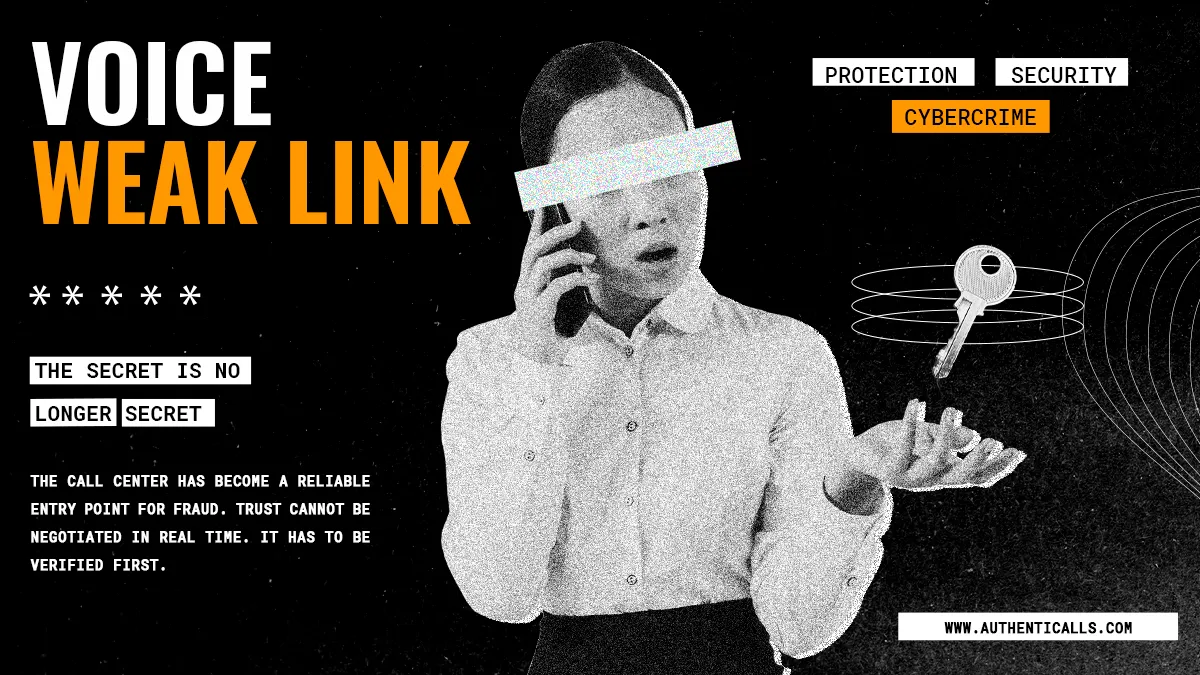

When the Voice Becomes the Weakest Link
For most people, cybercrime still feels like a technical problem, something that happens deep inside systems and networks. In reality, much of what enables modern fraud is already exposed long before any system is touched. Personal data has become abundant, fragmented, and easy to assemble. Breaches, data brokers, overshared profiles, recycled credentials, and leaked recordings have turned identity into a collection of reusable parts. With enough of them, impersonation stops being guesswork and starts to look routine.
This availability has quietly changed how attackers operate. Instead of forcing entry, they arrive prepared. When they contact a call center, they do not sound like strangers. They know names, locations, account details, recent activity. They speak with confidence because they are not inventing a story, only reciting one built from real information. Familiarity creates momentum, and momentum is often mistaken for legitimacy.
Technologies that were meant to improve efficiency have amplified this shift. Local number spoofing, automated dialing, and readily available personal information make malicious calls indistinguishable from ordinary ones. There is no technical anomaly to detect, no obvious signal that something is wrong. The call blends into the background noise of daily operations.
In this environment, the call center has become one of the most reliable entry points for fraud. Not because agents are careless, but because the tools they are given assume a world that no longer exists. Knowledge-based questions depend on the secrecy of personal information. Human judgment depends on the belief that deception is visible. Both assumptions collapse when attackers have access to the same data as legitimate customers.
Social engineering thrives in these conditions. A calm voice, a credible backstory, and a hint of urgency are often enough to guide a conversation toward exceptions and overrides. Kevin Mitnick demonstrated decades ago that people do not need to be tricked into doing something harmful; they only need to believe they are being helpful. Today, those techniques are no longer artisanal. They are standardized, scripted, and scaled across organized fraud operations that run call centers of their own.
What follows is rarely an immediate theft. More often, it is access. A password reset, a change of contact details, a temporary bypass of controls. From there, the damage unfolds quietly and downstream, far from the original call that enabled it.
The core weakness is not training or awareness. It is structural. Call centers are still asked to authenticate identity through conversation, at the very moment when conversation has become the attacker’s strongest weapon.
A different approach removes that burden entirely. With Authenticalls’ Call Center Authentication, identity is established before an agent ever joins the call. Through an IVR-generated code and voice recognition, callers are verified automatically and consistently. The system decides who is allowed to proceed, not the person on the line.
By the time a conversation begins, the question of identity has already been answered. There is no opening for persuasion, no room for urgency, no benefit to sounding convincing. Either the caller is authenticated, or the call does not advance.
This changes the nature of call center security. Operators are no longer positioned as human firewalls, expected to detect deception under pressure. They can focus on service rather than suspicion, while organizations gain a resilient authentication layer that does not depend on secrets that have already been exposed.
As voice fraud grows and impersonation tools become more accessible, this distinction becomes critical. In a world where data is easy to find and voices are easy to imitate, trust cannot be negotiated in real time. It has to be verified first.
Learn more about Authenticalls Call Center Authentication
https://authenticalls.com/call-center-authentication