
 Face Biometric Authentication
  Biometric Check with Voice Match
  Face Biometric 2FA/MFA
  SMS 2FA/MFA
  Call Center Authentication
  Voice Biometric 2FA/MFA
  Document verification
  Biometric KYC with Liveness Face Matching
  Biometric KYC with Liveness Face Matching and AML check
  Authenticalls Revenue Intelligence
  IdentySign

The Hidden Scale of SIM-Based Cybercrime, and the Role of KYC in Stopping It
From Europe to the U.S. and Asia, investigators are uncovering vast criminal networks built not on malware, but on unverified SIM cards. These operations show how easily anonymity can be weaponized, and why KYC is now the frontline defense for every telecom provider.
In the last year, several major international investigations have exposed just how vast and sophisticated telecom-based cybercrime has become. What these operations revealed is not only the ingenuity of modern fraud networks, but also the fragility of mobile ecosystems that still rely on anonymous SIM activations. When identity is unchecked, networks become open doors
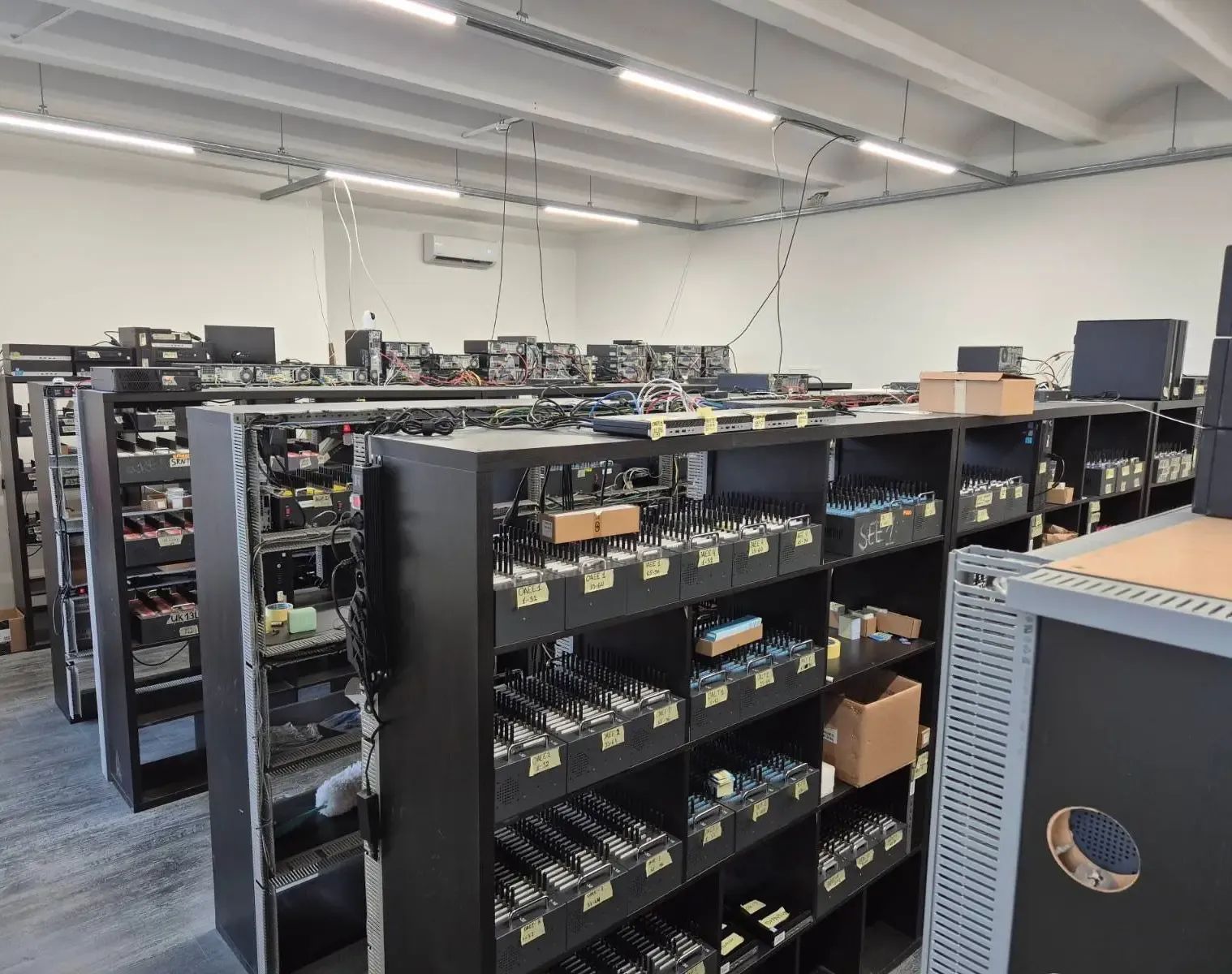
One of the most striking examples came from Europe this October, when Europol and the Latvian State Police announced the dismantling of a large-scale cybercrime infrastructure known as Operation SIMCARTEL. Behind it stood a well-organized network that had transformed SIM cards into tools for global fraud. Investigators seized over 1,200 SIM-box devices, 40,000 active SIM cards, and five servers used to route illicit traffic across multiple countries. The criminals were linked to more than 3,200 cyber fraud cases in Austria and Latvia alone, with losses exceeding €4.9 million. According to Europol, the service they built was used to create nearly 49 million fake online accounts, later employed in phishing, smishing, and investment scams.
Just a few weeks earlier, across the Atlantic, the U.S. Secret Service discovered another massive “SIM farm” operating in the New York area. Spread across multiple sites, it contained more than 100,000 active SIM cards, a scale so large that investigators warned it could have disrupted entire mobile networks. Similar findings have emerged from India and Thailand, where authorities have seized hundreds of thousands of SIM cards used for fake identities, OTP fraud, and large-scale financial scams.
These examples paint a clear picture of how cybercrime-as-a-service has evolved. Criminals no longer need to hack into systems; they simply rent access to anonymity. With enough unverified SIM cards, anyone can create thousands of false identities, automate fake accounts, send convincing phishing messages from local numbers, or bypass telecom fees through SIM-box routing. The result is a global criminal infrastructure that hides in plain sight: built not on code, but on weak identity checks.
At the center of this problem lies a single point of failure: the lack of robust Know Your Customer (KYC) processes during SIM activation. Each unverified subscriber becomes a potential node in a network of fraud. Without identity verification, carriers cannot know who they are connecting to their networks, and that uncertainty is exactly what organized crime exploits.
While many regulators have mandated SIM registration and identity verification, implementation remains uneven and often superficial. Yet every major investigation, from Europol’s SIMCARTEL to the U.S. telecom takedown, reaches the same conclusion: unchecked SIM activations are not a technical issue, but a structural vulnerability. They enable fraud, money laundering, misinformation, disinformation, and in some cases, can even threaten critical communication infrastructures.
The good news is that this risk is entirely manageable. With modern, technology-driven KYC processes, telecom providers can integrate identity verification directly into their existing workflows: seamlessly and without slowing down legitimate users.
At Authenticalls, we make this simple through voice- and face-based verification APIs that deliver real-time biometric confirmation at scale. Whether it’s for prepaid SIM activations or enterprise-level provisioning, our solutions ensure every subscriber is exactly who they claim to be fast, secure, and cost-effective.
Identity verification is no longer a compliance checkbox; it is the foundation of network integrity. Each verified SIM strengthens trust between operators and users. Each blocked fake activation reduces the attack surface for global fraud. And each proactive KYC policy sends a signal that the telecom industry is no longer the weak link in the cybersecurity chain.
As Europol’s latest operations make clear, the fight against telecom-enabled cybercrime begins long before any fraud occurs. It begins at activation and with knowing your customer.